Facial Plastic Surgery

Beverly Hills

What is Asian Rhinoplasty?

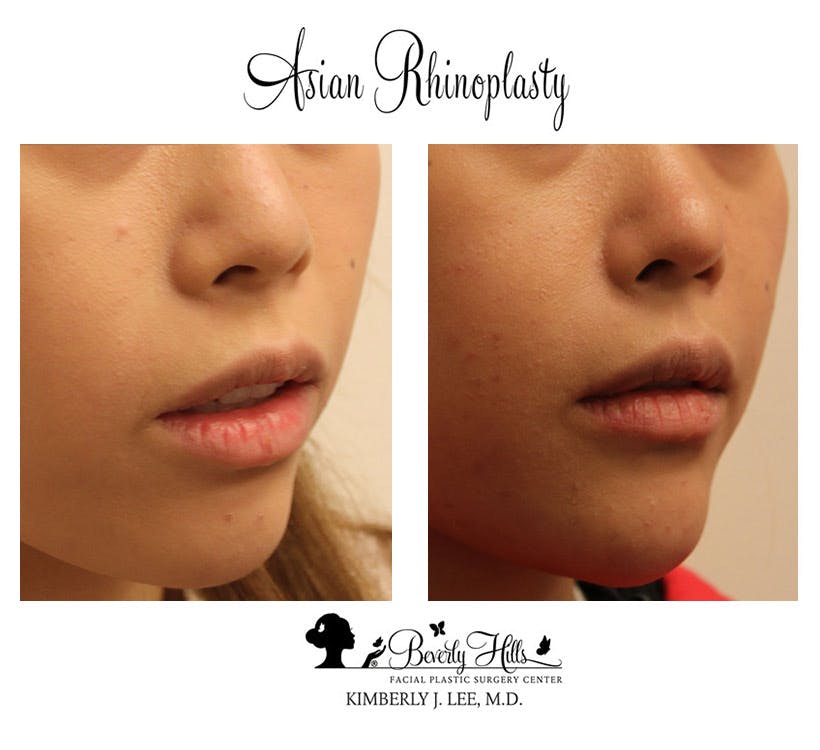
Asian rhinoplasty is a specialized form of nose surgery designed for patients of East Asian, Southeast Asian, and South Asian descent. Unlike standard rhinoplasty — which most often reduces a prominent dorsum or refines a long tip — Asian rhinoplasty is primarily an augmentation procedure. The surgeon builds projection at the bridge, refines an under-projected tip, and narrows wide nostrils, all while preserving the patient's ethnic identity.

Asian noses tend to share several anatomical features that guide surgical planning: a lower nasal bridge, a short columella, weaker lower lateral cartilages, and thicker overlying skin. These features call for structural reinforcement — typically via cartilage grafts and occasionally via alloplastic implants (artificial devices or materials used to replace or enhance a part of the body) — rather than the cartilage removal more common in standard rhinoplasty.

At Dr. Kimberly Lee's Beverly Hills practice, the goal of Asian rhinoplasty is never a "westernized" nose. The aim is balance and harmony: a refined version of the patient's own features that complements the rest of the face.

Asian Rhinoplasty Before & After

View More
Logo media
woman looking over her shoulder

Common Asian Rhinoplasty Procedures

Common requests from our patients include:

  • Thinner nasal bridge
  • Augmenting the nasal dorsum
  • Increasing the projection of the nose
  • Defining the tip of the nose to something more flattering
  • Changing the shape of the nostrils

Asian rhinoplasty is one of the most challenging ethnic rhinoplasty procedures that facial plastic surgeons encounter, second only to the lack of a nasal dorsum and a weak cartilaginous framework, combined with thick skin and a soft-tissue envelope.

The Dr. Kimberly Lee Difference

For Asian Rhinoplasty 

  • She has an intuitive understanding of the unique needs of Asian rhinoplasty patients.
  • She is a double-board-certified plastic surgeon and a rhinoplasty specialist who underwent elite Fellowship training in Facial Plastic and Reconstructive Surgery.
  • She received the Vitals Lifetime Achievement Award in Honor of Excellence in 2024.
  • She has received national and international recognition in the media, appearing on such shows as The Doctors, Inside Edition, and The Bonnie Hunt Show.

Real Patient Testimonial

My mother in law had a procedure done here and everything went outstanding. We interviewed several different doctors before deciding on dr. Lee. As soon as we met with her, we knew she was the one. Her bedside manner, staff and of course her work is amazing. From the consult, to the surgery everything went so smooth. Not only is she great but everyone who works around her is nice and comforting. My mother in laws surgery went well and she loves her results so far.

K.C.

Who is a Candidate For Asian Rhinoplasty?

Ideal candidates for an Asian rhinoplasty in Los Angeles & Beverly Hills want a subtle enhancement to the shape of their nose without compromising cultural identity. Asian rhinoplasty is a perfect procedure for someone who is looking to alter the width of their nose or nostrils or to enhance the nasal tip or nasal bridge. A minimalist approach is critical if you are considering an Asian rhinoplasty and should bring balance and harmony without creating any distracting or drastic changes. Candidates should also:

  • Be in good physical and emotional health
  • Have realistic goals and expectations
  • Be a non-smoker or willing to quit for six weeks before and after surgery

Banner media

Refined Techniques for a Defined Nasal Tip in Asian Rhinoplasty

A common request in Asian rhinoplasty is achieving a more defined and less bulbous or protruding nasal tip. Historically, this was achieved through aggressive resection of the lower lateral cartilages.

However, this approach often resulted in a loss of projection, a downturned or bulbous tip, contour irregularities, and possible long-term nasal obstruction. 

Dr. Lee takes a more refined approach, avoiding aggressive cartilage removal to preserve the nose’s natural structure. 

By using conservative techniques, she ensures better long-term results and reduces the need for revision rhinoplasty surgeries. 

Dr. Lee’s philosophy of “less is more” minimizes complications and enhances outcomes, making her one of the top surgeons for Asian rhinoplasty in Los Angeles and Beverly Hills.

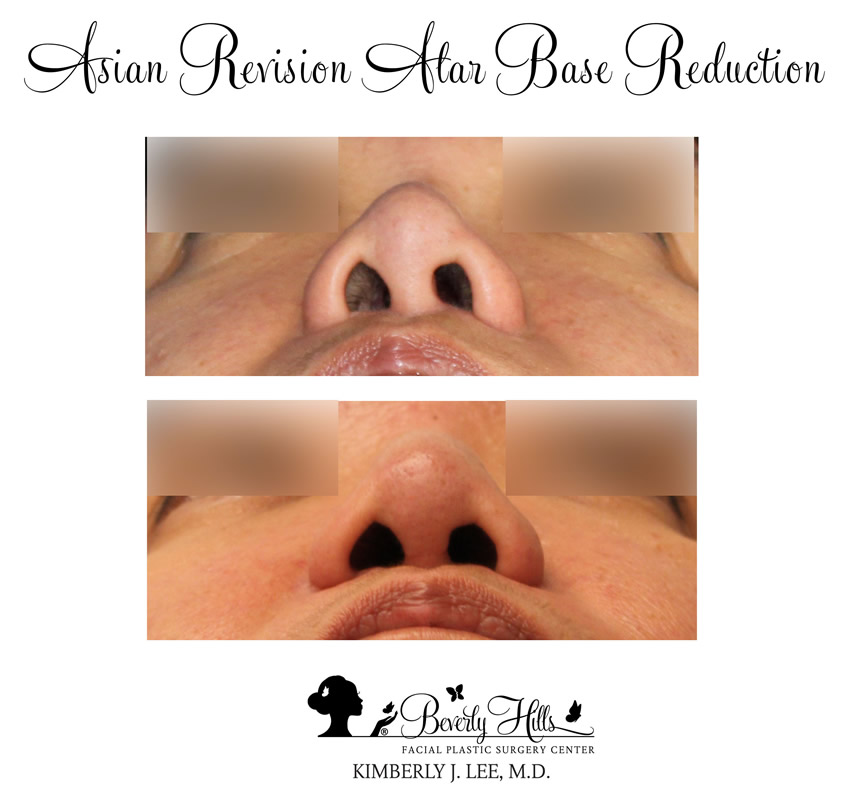
Additionally, Dr. Lee offers Alar Base Reduction as part of her procedure, which helps achieve facial harmony by narrowing the span of the nostrils. This can be done alone or combined with other nose treatments to achieve your desired look.

Asian rhinoplasty in Los Angeles and Beverly Hills

Asian Rhinoplasty Recovery: Week-by-Week Timeline

Recovery from Asian rhinoplasty follows a predictable arc, but Asian patients should plan for a longer tip-refinement window than the average rhinoplasty timeline. Thicker skin and the structural grafting used to build projection both lengthen the period during which residual swelling can mask the final result.

Week 1 (Days 1–7): Cast Removal & Early Healing

Bruising and swelling peak in the first 72 hours. Most patients keep their head elevated above heart level for the first week and use cold compresses for the first 48 hours. The external splint or cast is removed at the end of week one. Most patients return to non-strenuous work around days 7–10.

Weeks 2–4: Bruising Resolves, Tip Stays Swollen

Bruising is largely gone by week three. Swelling around the bridge improves quickly, but the nasal tip remains swollen and slightly numb. Light cardio can typically resume around week three; strenuous lifting, contact sports, and bending over remain off-limits until week six.

Months 1–3: Eighty Percent of Swelling Resolves

By the end of month three, roughly 80% of swelling has resolved and the new shape is clearly visible. Most patients feel comfortable in photos and social settings. Subtle asymmetries that were present early often soften as scar tissue matures.

Months 6–12: Refinement Continues

At six months, the nose has typically reached about 80% of its final form. Tip definition continues to sharpen as deeper tissues settle. This is the point at which most patients feel their result has "settled."

Months 12–18: Final Tip Refinement (Asian-Specific)

Final results in Asian rhinoplasty are typically not visible until 12–18 months, meaningfully longer than the 6–12 month timeline often quoted for thinner-skinned patients. The thicker soft-tissue envelope takes longer to drape over the new structural framework. Patience during this window is critical.

Recovery Tips That Make a Real Difference

  • Keep your head elevated, even when sleeping, for the first two weeks.
  • Use cold compresses for the first 48 hours, then switch to room-temperature compresses to support healing.
  • Avoid blowing your nose and strenuous activity for 2 to 3 weeks.
  • Do not wear glasses on the bridge of your nose for at least 4–6 weeks. Tape glasses to your forehead or use contact lenses.
  • Avoid all nicotine — including vaping and patches — for at least six weeks before and after surgery. Nicotine is one of the leading preventable causes of healing complications.
  • "80% of swelling resolves by 3 months; final tip refinement at 12–18 months" — Aesthetic Surgery Journal review data on Asian rhinoplasty timelines https://pmc.ncbi.nlm.nih.gov/articles/PMC4174207/

Procedures Commonly Combined for Facial Harmony

Chin Augmentation

A subtle or recessed chin can make a nose appear larger or out of proportion. Chin augmentation, typically done with implants or fillers, can improve facial profile and enhance the overall results of rhinoplasty. Combining these procedures allows Dr. Lee to create a more balanced and masculine or feminine profile in a single recovery period.

Eyelid Surgery (Asian Blepharoplasty)

Asian eyelid surgery, or double eyelid surgery, is a popular companion procedure to Asian rhinoplasty. By refining the eyelid crease or removing excess skin, eyelid surgery can harmonize the upper and lower face, complementing the nose for a more refreshed and natural look.

Facial Contouring

Procedures like jawline contouring or cheek augmentation can further enhance facial symmetry. When performed alongside Asian rhinoplasty, these treatments help create a proportionate, aesthetically pleasing facial structure.

Non-Surgical Enhancements

Some patients opt for non-surgical procedures in combination with Asian rhinoplasty. Injectable fillers, Botox®, or skin treatments can refine the overall appearance, enhance features, and improve the final aesthetic results without additional downtime.

Background media

Asian Rhinoplasty Cost in Los Angeles & Beverly Hills

Asian rhinoplasty in Los Angeles and Beverly Hills typically ranges from $12,000 to $35,000 or more. Prices vary based on surgical complexity, the surgeon's experience, the operating facility, and whether complementary procedures are performed in the same session.

Asian rhinoplasty consistently lands above the standard rhinoplasty range because the procedure requires augmentation rather than reduction. Building a refined bridge and tip involves cartilage harvesting, structural grafting, and longer operative time — all of which add cost.

What's Included in Your Quote:

  • Surgeon's fee — reflects experience, specialty, and time in the operating room
  • Anesthesia — board-certified anesthesiologist for general anesthesia
  • Surgical facility fee — accredited operating room and recovery suite
  • Pre-op imaging — including Vectra 3D simulation when used
  • Grafting materials — additional fees may apply for rib cartilage harvest or implants
  • Post-operative visits — included for the first year in most cases

Asian Rhinoplasty by the Numbers

Asian rhinoplasty has been studied extensively in the peer-reviewed literature, and the numbers tell a clear story: outcomes are excellent in experienced hands, but surgeon selection materially affects complication and revision rates.

Metric

Reported Rate / Range

Post-rhinoplasty infection rate

1–2% across all primary cases

Silicone implant complication rate (Asian rhinoplasty)

~16% overall (5.3% infection, 2.8% extrusion)

Implant removal rate — silicone vs Gore-Tex / Medpor

6.5% silicone vs 3.1% Gore-Tex / Medpor

Autologous cartilage graft complication rate

Less than 1% in most published series

Revision rate — specialist vs generalist surgeon

5–10% with specialists; up to 20%+ with generalists

Patient satisfaction with specialist Asian rhinoplasty

Over 90% in published outcome series

Two takeaways stand out. First, autologous cartilage — the patient's own tissue — has a meaningfully lower complication profile than alloplastic implants in the long term, which is why Dr. Lee favors cartilage when the anatomy supports it.

Second, choosing a fellowship-trained specialist who regularly performs Asian rhinoplasty is one of the most significant controllable factors in your outcome.

Source: Aesthetic Surgery Journal review data on "Current Update in Asian Rhinoplasty" https://pmc.ncbi.nlm.nih.gov/articles/PMC4174207/

Banner media

Asian Rhinoplasty FAQs

How much does Asian rhinoplasty cost in Los Angeles?

What is the revision rate for Asian rhinoplasty?

Can men get Asian rhinoplasty?

How is Asian rhinoplasty different from Korean rhinoplasty?

Are there any risks?

How long does surgery take?

How is Asian rhinoplasty different from other ethnic rhinoplasty surgeries?

Will it look natural?

Will there be scars?

Can I breathe normally immediately after surgery?

When can I wear glasses again?

How much does Asian rhinoplasty cost in Los Angeles?

Asian rhinoplasty in Los Angeles and Beverly Hills typically ranges from $12,000 to $35,000 or more, depending on complexity. The procedure costs more than standard rhinoplasty because Asian noses generally require augmentation, cartilage grafting, and structural reinforcement, all of which add operative time and technical demand. A consultation is the only reliable way to get an accurate quote for your case.

What is the revision rate for Asian rhinoplasty?

Published series report revision rates of roughly 5–10% for primary Asian rhinoplasty when performed by a fellowship-trained specialist, and up to 20% or more when performed by surgeons who don't focus on rhinoplasty. The strongest predictor of avoiding revision is choosing a surgeon who performs Asian rhinoplasty regularly and uses conservative, structure-preserving techniques.

Can men get Asian rhinoplasty?

Yes — Asian male rhinoplasty is one of the fastest-growing areas of facial plastic surgery. The goals are different from female rhinoplasty: a strong, straight bridge, a slightly less rotated tip, and overall masculine proportions. Asian men also tend to have thicker skin than Asian women on average, so tip refinement timelines are slightly longer. Dr. Lee performs Asian rhinoplasty for men regularly. See our dedicated page on Asian rhinoplasty for men for more detail.

How is Asian rhinoplasty different from Korean rhinoplasty?

Asian rhinoplasty is a category that includes patients of East Asian, Southeast Asian, and South Asian descent. Korean rhinoplasty is a specific surgical tradition that developed in South Korea, historically known for silicone bridge implants and prominent tip projection. Many U.S. specialists, including Dr. Lee, use techniques refined in Korea while favoring autologous cartilage over silicone implants for safety and a softer, more natural appearance.

Are there any risks?

Risks associated with this procedure include the risks that are associated with any surgical procedure. Risks such as bleeding, bruising, swelling, and possible infection are the most common. By carefully following the post-op instructions, you can minimize the risk and side effects. The most critical matters are ensuring the surgery is performed correctly, and that you achieve a result that meets your expectations.

How long does surgery take?

Asian rhinoplasty can take between one to three hours or longer, depending on the complexity of the surgery.

How is Asian rhinoplasty different from other ethnic rhinoplasty surgeries?

Asian rhinoplasty differs from other ethnic rhinoplasty surgeries as it represents a culturally unique nasal shape and structure. Noses are one of the most widely varied aspects of the human face, revealing your ethnic background. A deep appreciation of Asian beauty, differences in skin, and how to best enhance structure is vital when performing Asian rhinoplasty.

Will it look natural?

The aim is always to look as natural and untouched as possible. To achieve a look that appears entirely natural, select the right surgeon to perform your Asian rhinoplasty. Dr. Lee aims to provide an Asian-specific procedure that creates greater balance, beauty, and harmony among your features while enhancing all of your attractive features.

Will there be scars?

Scarring will be minimal as the incisions are placed in discreet locations. Depending on the surgical approach used, scars are hidden within the nostrils. If an open rhinoplasty approach is appropriate, the scar will be almost invisible, as it is placed at the base of the column between the nostrils.

Can I breathe normally immediately after surgery?

Immediately after surgery, nasal passages may feel congested due to swelling or temporary packing. Most patients experience gradual improvement and can breathe comfortably within a few weeks. Dr. Lee carefully preserves nasal function during surgery to ensure both aesthetics and airflow are optimized.

When can I wear glasses again?

Glasses should generally be avoided for the first 4–6 weeks after surgery to prevent pressure on the healing nasal bridge. During your consultation, Dr. Lee will provide personalized guidance depending on the surgical techniques used and your anatomy.

Doctor media

Why Choose Dr. Kimberly Lee?

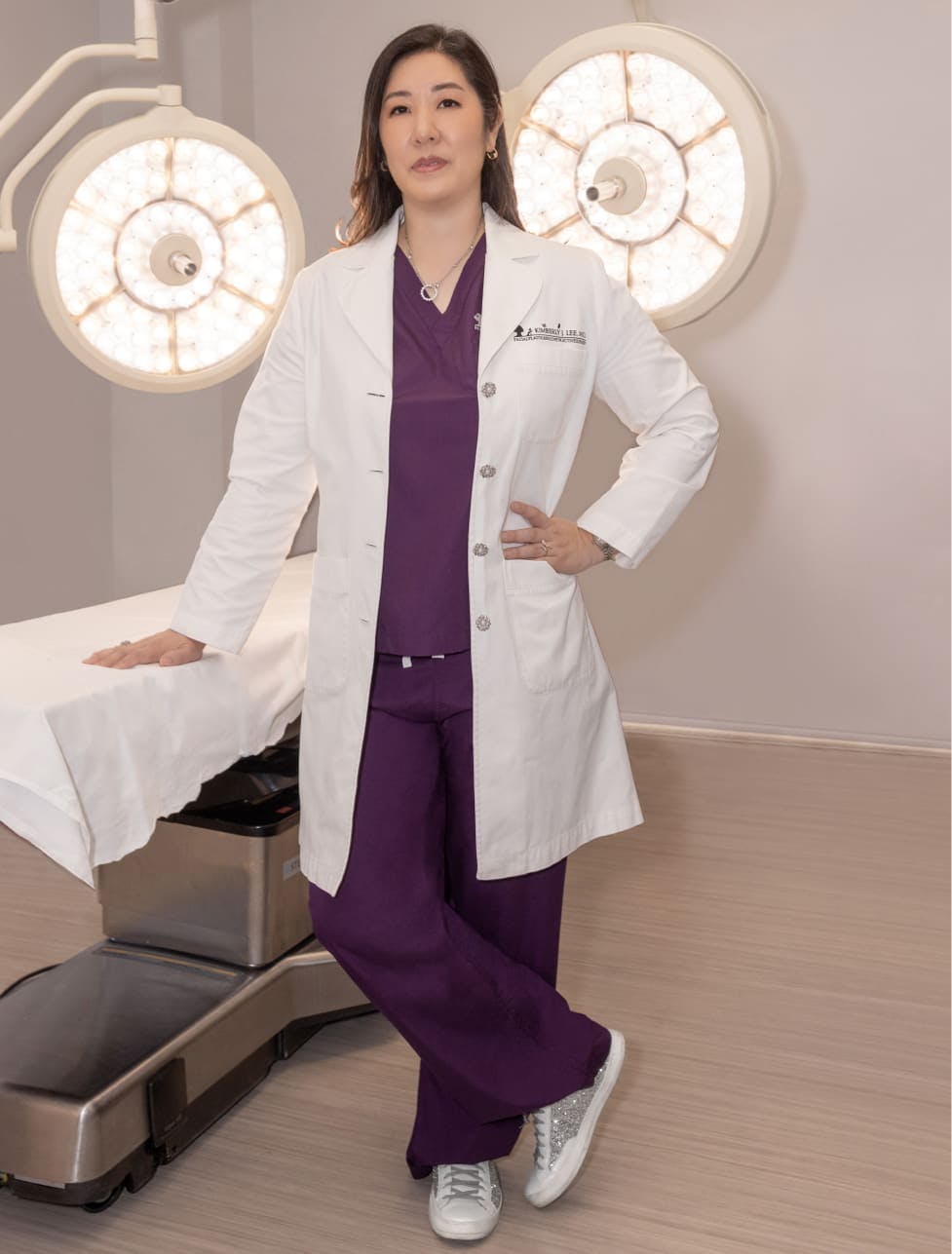
Dr. Kimberly Lee, a double board-certified plastic surgeon, specializes in Asian rhinoplasty. Her deep understanding of facial anatomy and precision technique ensures natural-looking results. Dr. Lee collaborates with patients to enhance their beauty and comfort while complementing their facial structure. Many opt for a chin augmentation alongside Asian rhinoplasty, and Asian eyelid surgery is often performed shortly after. Choose Dr. Lee for exceptional care and tailored results.

Doctor credentials
Doctor credentials
Doctor credentials
Doctor credentials

Plastic Surgery Saved My Life" – A Life-Changing Discovery - Read the Full Story

test

TAKE YOUR FIRST STEP

Schedule Your Consultation

Reach out and speak with a member of our dedicated staff, and take those first exciting steps on your empowering cosmetic journey today.

In Office Virtual
Contact us media
Accessibility: If you are vision-impaired or have some other impairment covered by the Americans with Disabilities Act or a similar law, and you wish to discuss potential accommodations related to using this website, please contact our Accessibility Manager at (888) 417-8101.
Contact Us